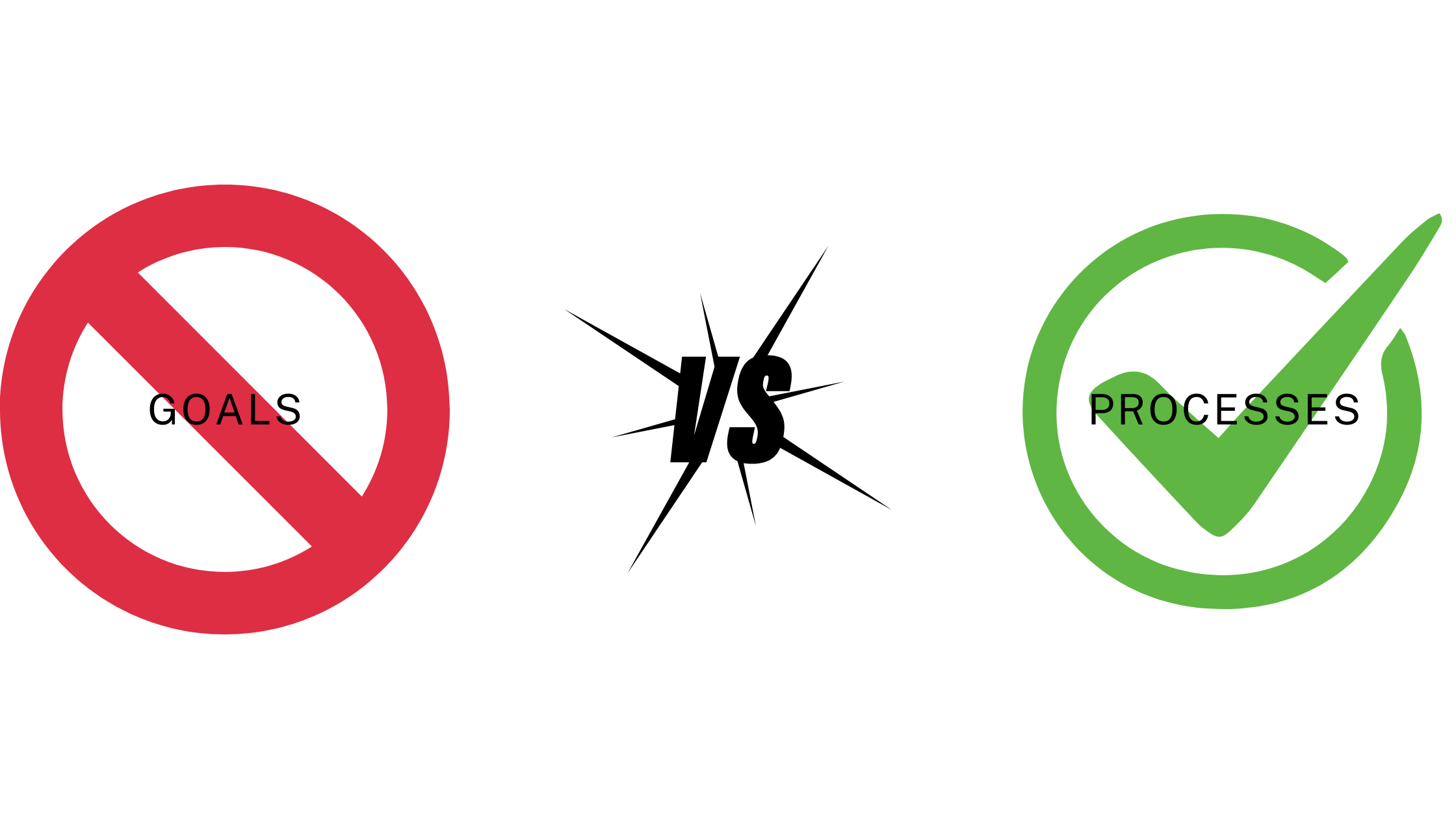
Yeah, Andrea, how the hell do you set language learning goals, and above all, how do you really reach them?
Ok, if you have a little patience, today I will tell you couple of counterintuitive things that might actually disturb you, at the beginning…and that significantly contradict many mantras in the self-help, motivational and self-growth circles. But if you give it a thought, you’ll undersand that what I am trying to do with this biref article is to give the power back to you. And that might even excite you, for sure it should give you solace.
Not making any sense, am I? Ok, here are today’s article topics:
- goal setting will take you nowhere but to frustration…I said it.
- processes are what you really want to do
- systems and habits are the thing that will “learn you a language”
Ready? Let’s go!
Language learning goals don’t work
You read it right. Goal setting is a myth in that it does not help you getting better, not always at least.
Goals can fuel your motivation and excite you for a while, but then you realise that the fact that you want to reach a goal, that you even wrote it down, as they instruct you to do, does not bring you any closer to reaching it. And this is the first problem.
It’s not only up to you
But let’s delve a little more into this. In the whole rhetoric of goal setting we always forget an important detail: we do not live in a fish tank and things do not happen only just because we will them to. The mere fact that you want something with all you heart and do everything you can, sacrifice everything else, abandon any other part of your life to get it, does not mean that you will actually get there.
Let’s take an example that motivation gurus love: Jeff Bezos. “He started in a garage and wanted it so bad, worked so hard, that failure was not an option”. Ever read something along the lines of this? Ok, this is TOTAL BULLSHIT. I am not afraid of saying this. And the reason is very simple, and it’s called “survivorship bias”.
This cognitive bias is what explains why the reasoning behind the myth of Bezos or others like him is fallacy-ridden. To say it simply, the myth takes into consideration only those that made it and their effort to get to success, forgetting in their entirety all those that did exactly the same things, had very good ideas, had the the same work ethic and worked as hard, but due to external circumstances did not have the same result.
Shortly, they forget to add luck, chance, chaos in the equation. In a language learning perspective, we could use a level certification. You might have studied very hard, know everything you need to know to get your C1 certificate, but:
- you get emotional when you have to speak because the examiner looks unnerved
- they ask you to write about a topic you know nothing of in the written part of the exam
- your car breaks down and you can’t reach the examination premises on time, so they exclude you from taking part
- locusts (if you did not get this reference, see the video below)
Bottom line, you having worked your ass off might not be enough to get you the C1 you long to have.
Goals are not durable
The second problem with goals is that they do not last. A goal is a fixed point in time, so to say, and once you have reached it, it’s gone. You need another one to keep on doing the things you want to do and that supposedly helped you get there.
This is better explained with our relationship with food and weight. Let’s say that you are overweight and want to get in shape. You set the weight you want to reach as a goal. This is a very bad choice, as far as fitness parameters are concerned, but this is not the place to discuss nutrition and training.
Suppose you reach your weight goal, what do you do next? Do you stop eating like you did to get there and go back to the bad habits that made you out of shape? Do you set another goal to lose even more weight? There is only so much body mass you can shed.
Let’s use a language related example, because I can almost hear you getting triggered by this topic. Let’s take the C1 certificate, as before.
You pass the examimation with flying colours, now what? Do you stop speaking, reading, revising grammar? Do you set the goal of becoming a philologist in your TL (target language)?
You see, the problem, I think. And this takes us to the third reason why you should not set language learning goals, or any goals, for that matter
Expectations will kill you (and your future improvements with you)
I know, I tend to be dramatic…that must be my mediterranean upbringing, who cares. Now, after telling you that golas setting is evil, I will recede from my position and tell you that it’s not goals per se that are a problem. It’s the expectations we put on them.
You set a goal, what can happen? Two things, you either reach it or you don’t.
If you don’t, you might give into frustration, develop a limiting belief about yourself and decide that it is pointless to go on. You give it all up. And this is a mistake, because as we saw before, you reaching your goal can depend on a lot of factors that have nothing to do with you. So it is not fair that you blame it all on yourself, even less fair that you renounce something that is important to you because you think you are not able or do not deserve to get it.
On the other side of the spectrum, you might reach your goal. OK, and now what? Your sense of self-accomplishment will last not much more than the goal itself, and you will be left with literally nothing, but another goal to set, which in some cases might even be impossible. What can you possibile hope to achieve more than a C2? Not much. Again frustration might kick in.
So, is that all there is to it? How will I measure my progress when I start to learn a language, if I can not set goals? Don’t worry, I will give you another perspective.
Of processes, systems and habits
Language learning is a process, and it can (should, if you ask me) be a never-ending one. It’s not a destination. So it really makes not sense at all to set language learning goals, whereas it does make sense to create a process, a system that will get you to implement the language in your life and make it part of you.
Systems or processes have two main features that are extremely advantageous in language learning (but not only, I’d argue):
- they’re durable and extendable
- they dipend entirely on you
Incidentally, they might even get you to the goal you thought you needed to reach to feel better. Now, to be effective the processes you set must have three carachteristics:
- they must be proven
- they must be constant
- they must be right for you
Are you sure your system works?
This is pretty obvious. You must make sure that what you do has a certain degree of reliability as far as its effectiveness is concerned. In other words, I would recommend that you look for systems that worked for others, instead of trying out things that have no proven record.
It’s not a process if it does not last
You will have to repeat it if you hope to reap some results. Discipline is what comes into play here. Habits make systems and processes easiER, not easY. You will still have to put in the hours, the energy, your will.
Personalisation, impossible to overestimate
All the above will mean shit if the process is not suitable for you, your needs, your schedule etc. To start studying using a method you find difficult if not impossible to apply, because you have other priorities, or because it is plainly designed on someone that is not you, will be a source of extreme frustration.
Because you will not learn as much as you could, and on top of this, you will hate every moment of it.
Putting the focus on the process gives you all the power and it takes a big weight off your chest, that feeling of inadecuacy that not reaching a goal might lay upon you.
It’s a very powerful reframing and you can use it in anything in your life.
A rule of thumb
All of the above leaves us with a conundrum about how to evaluate our linguistic competence. If setting goals does not work, how do I know how good I am?
This would probably deserve an article in itself, because how good you are does indeed depend a lot on your specific needs and not only on some standardised test.
But let’s say it shortly. If you need a certification for any reason, just use that as a way of measuring your progress.
If you don’t, and are studying the language out of sheer interest, “use your feelings, Luke!”. I mean, test your knowledge by using the language with a certain continuity. I did say that language learning is a process, and if you learn a language and do not use it, what’s the point?
So, can you speak for 5 minutes about something you are interested in? Can you read a book not scrolling pages and pages with no understanding whatsoever of what is going on? Do you understand short videos? Can you enjoy a film?
All of the above are not scientific methods and will not give you a definite answer, because you will experience setbacks, and maybe understand a film perfectly and not get a word of the following one. But at the end of the day, you are the only one that can judge if your level of linguistic competence is satisfying to you. And you must enjoy the process.
Are we done?
Yes we are. Let’s recap. Language learning goals do no work, or to say it mildly, are not ideal. It is much better to implement a process, because learning a language is a process, whereas goals are temporary. A part from this, they do not depend entrely, most of the times not even remotely, on you, so they are not enough to bring about the change you want in your life (in our case, fluency in a language).
If you feel like going deeper on this, by the way, I took most of the ideas in this article from the book “Atomic Habits”, by James Clear.
From that book comes this quotation I will leave you with:
“Winners and loosers have the same goals”…so do what really makes a difference, estabilish processes.
I want you to know that everything that allowed me to learn 5 languages is here, for you to use. But let me ask you…
Do you still feel stuck? Are you unsure about how to start learning your target language? You’ve started and don’t know how to go on?
Send me an email at andrea@thehikingpolyglot.eu.
We will schedule a free coaching session (30 mins). We will assess together where you are and what you can do to go on.
Can’t wait to talk to you personally!